ISO Certification. (CertiBiz) – Your Partner in Global Certification Excellence.
In today’s competitive and fast-changing global market, every business,big or small,needs credibility, compliance, and confidence to stand out. At CertiBiz, we help organizations across every industry achieve international recognition through globally accepted certifications such as ISO, CE Mark, HACCP, CMMI, and VAPT.
Our mission is simple: to make certification easy, affordable, and meaningful. Whether you are a startup in India, a manufacturer in Saudi Arabia, a tech company in Singapore, or a logistics firm in the UAE, we are your trusted partner in achieving global standards of quality, safety, and performance.
What is ISO Certification?
The International Organization for Standardization (ISO) is a global group that creates voluntary standards used worldwide. It’s independent and not tied to any government. ISO has 162 member countries, each represented by its national standards organization. The main office, called the Central Secretariat, is located in Geneva, Switzerland.
- Officially in 1946, representatives from 25 different countries met in London at the International Institute of Civil Engineers.
- They decided to create a new international organization to coordinate and unify industrial standards worldwide.
- ISO formally began its successful journey in February 1947.
- Since its creation, ISO has published over 21000 International Standards.
- These standards cover almost every area of technology, manufacturing, and the hospitality industry.
- ISO now has members from 162 different countries.
- There are 3368 technical groups responsible for developing ISO standards.
- Over 150 people work full-time at ISO’s main office (Central Secretariat), which is based in Geneva, Switzerland.
Why Organizations Need ISO Certification ?
After implementing ISO standards in their business, organizations can contact an accredited certification body to conduct an independent evaluation, known as a certification audit. This audit checks if the organization meets the requirements of the chosen ISO standard. If they pass, they receive an ISO certification and can call themselves an ISO-certified company.
However, not all ISO standards can be certified. Only those standards that include specific requirements for organizations to follow can be certified by a certification agency.
Why was ISO formed?
During World War II, many countries were involved in the conflict and faced major issues with supplies. This happened because each country followed its own manufacturing standards, leading to confusion and inefficiency. The lack of uniformity in product manufacturing caused problems, and this situation sparked the idea of creating a single, global standard for industries that everyone could follow. This idea eventually led to the formation of ISO. Below are few more reasons why ISO came into existence:
- Before ISO standards were published and adapted, different countries and industries had their own standards, which made international trade and cooperation difficult because there was a lack of uniform standard business practices.
- There was an emerging demand for consistent and acceptable international standards to ensure quality, health, safety, and efficiency in products and services globally.
- Standardization and uniformity in industrial practices helps to remove technical barriers to trade and makes it easier for countries and businesses to work together to facilitate international trade.
- Uniformity in industrial standards streamline processes, reduce waste, and improve productivity across various industries and bring in industrial efficiency.
- ISO was established to bring countries together to promote worldwide collaboration and to agree on common standards, boosting cooperation and innovation on a global scale.
- ISO was formed to make global trade more connected, efficient, and consistent by developing universal standards.
What does ISO (International Standard for Organizations) do?
The technical committees, made up of experts from member countries and full-time ISO employees, focus on understanding market trends, global trade practices, new challenges, technologies, and the needs of emerging industries. Their goal is to create uniformity and align industrial practices worldwide.
These committees develop ISO standards for various industries and publish them on ISO’s website. Organizations that want to follow these standards must buy the ISO standard documents, understand the requirements, and implement them in their business operations. Only then can they claim to be ISO-compliant companies.
Does ISO certify organizations?
No, ISO (International Organization for Standardization) does not certify organizations. Its role is to create and publish standards and guidelines to promote uniformity in industrial practices. ISO does not authorize or certify any organization, nor does it require organizations to get certified. Certification is optional and done by independent certification bodies, not by ISO itself.
How can organizations become ISO certified?
After implementing specific ISO standards, organizations can contact an accredited certification body. These certification bodies are authorized by accreditation bodies to issue ISO certificates. They will conduct a conformity assessment (audit) to check if the organization meets the standard’s requirements. If the audit is successful, the organization will receive an ISO certificate.
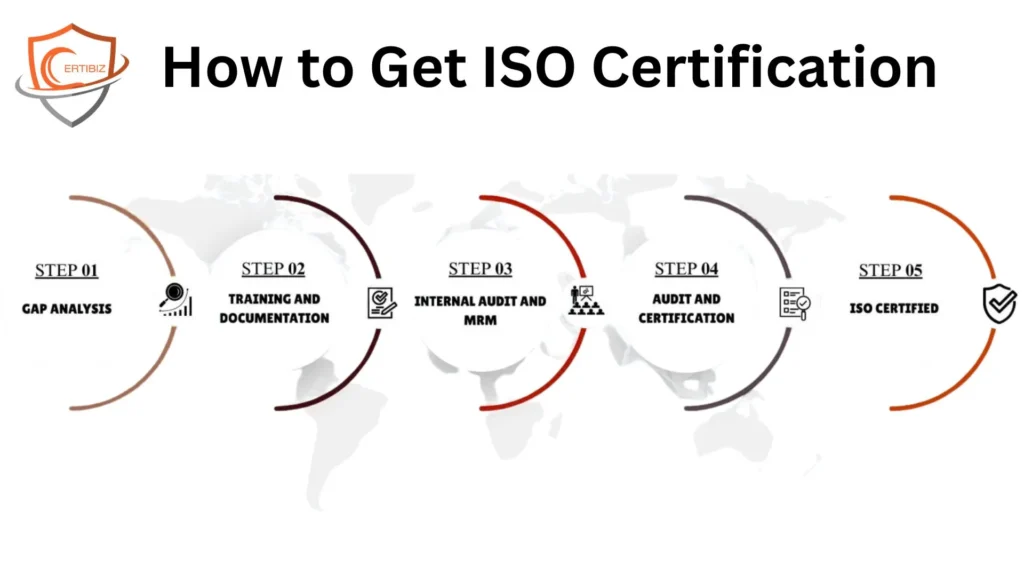
How to Get ISO Certification-Our effective implementation steps:
All Certification Standards We Offer?
We provide end-to-end consultation and assistance for a wide range of international certifications and management systems.
ISO 9001 – Quality Management System
Establishes consistent quality standards across your operations, ensuring customer satisfaction, process efficiency, and continual improvement.
ISO 14001 – Environmental Management System
Helps businesses reduce environmental impact, comply with sustainability laws, and promote eco-friendly operations.
ISO 45001 – Occupational Health & Safety
Protects employees and enhances workplace safety by implementing proactive risk management strategies.
ISO 50001 – Energy Management
Improves energy efficiency and reduces costs by optimizing energy use across your organization.
ISO 27001 – Information Security Management
Safeguards sensitive business data, protects against cyber threats, and builds client confidence.
ISO 22000 / HACCP – Food Safety Management
Ensures food quality, hygiene, and safety across production and supply chains. Essential for all food-related businesses.
ISO 22301 – Business Continuity Management
Prepares organizations to manage disruptions effectively and maintain critical operations during crises.
ISO 21001 – Educational Organizations
Improves education delivery and institutional management through quality and learner-focused systems.
ISO 13485 – Medical Devices Quality Management
Ensures compliance with global medical device manufacturing and quality standards.
ISO 28000 – Supply Chain Security Management
Secures logistics and transportation networks by reducing risks and improving supply chain reliability.
ISO 22483:2025 – Tourism & Accommodation
Designed for hotels and resorts, this standard improves service quality, sustainability, and guest satisfaction.
CE Mark Certification
Mandatory for products sold in the EU and EEA regions, CE Marking ensures your products meet safety, health, and environmental protection requirements.
CMMI – Capability Maturity Model Integration
Optimizes IT and software processes for improved performance, quality, and delivery consistency.
VAPT – Vulnerability Assessment & Penetration Testing
Protects your business from cyberattacks by identifying vulnerabilities and providing actionable security insights.
At CertiBiz, we combine deep domain expertise with international knowledge to guide you toward the right standard for your goals.
Benefits of Getting Certified with CertiBiz?
When you partner with CertiBiz, certification becomes a catalyst for growth—not a compliance headache.
Key Benefits:
- Enhanced Credibility: International recognition boosts client confidence.
- Operational Efficiency: Streamlined processes reduce waste and errors.
- Market Expansion: Certified organizations gain easier access to global markets.
- Legal & Regulatory Compliance: Meet national and international requirements effortlessly.
- Employee Engagement: A safe and quality-driven culture improves morale and performance.
- Risk Reduction: Identify potential issues before they become costly problems.
- Sustainability: Align operations with global environmental and social standards.
Industries We Serve
We serve a broad range of industries across continents. Our consultants understand the unique challenges each sector faces and tailor certification solutions to meet specific goals.
Industry | Focus Certifications |
Manufacturing | ISO 9001, ISO 14001, ISO 45001, ISO 50001, CE Mark |
Oil & Gas / Energy | ISO 45001, ISO 14001, ISO 50001, ISO 27001 |
Information Technology / Startups | ISO 27001, ISO 22301, ISO 9001, VAPT |
Food & Beverage / Agriculture | ISO 22000, HACCP, ISO 14001, ISO 9001 |
Construction & Engineering | ISO 9001, ISO 45001, ISO 50001, ISO 14001 |
Healthcare & Pharma | ISO 13485, ISO 9001, ISO 14001, ISO 45001 |
Education & Training | ISO 21001, ISO 9001, ISO 45001 |
Tourism & Hospitality | ISO 22483:2025, ISO 9001, ISO 14001 |
Transport & Logistics | ISO 9001, ISO 28000, ISO 45001, ISO 14001 |
Financial & Corporate Services | ISO 27001, ISO 9001, ISO 22301 |
No matter your sector, CertiBiz brings the same professionalism, attention, and international reach to help you achieve compliance and business excellence.
Our Simplified Certification Process
We make certification simple and efficient through a transparent and guided process.
- Initial Consultation: Understand your business goals, operations, and certification needs.
- Gap Analysis: Assess your current system against the selected standard requirements.
- Documentation & Training: Assist in policy creation, system documentation, and employee awareness.
- Implementation Support: Guide you in applying new systems and ensuring compliance.
- Internal Audit: Evaluate readiness and identify areas for improvement.
- External Certification Audit: Coordinate with accredited certification bodies for final assessment.
- Certification Achievement: Receive your certification after successful audit completion.
- Continual Support: Post-certification maintenance, surveillance audits, and renewals.
This structured approach helps you achieve certification seamlessly and maintain compliance with minimal disruption.
What is the role of a consulting company during the ISO certification process?
Hiring an ISO consultant can be very helpful because they are experts in this field. They usually have a team with diverse industrial experience and deep knowledge of ISO standards. They can provide customized solutions and make it easier for you to meet ISO requirements. When choosing a consultant, make sure they are available when you need them, have relevant experience in implementing the ISO standard you need, can he
Cost of ISO Certification?
The cost of ISO certification depends on several factors such as your organization’s size, type of industry, number of employees, and the specific ISO standard you wish to achieve. Each business operates differently, so the certification process is customized to meet its unique structure and goals.
Typically, the overall cost covers activities like gap analysis, documentation support, employee training, internal audits, and final certification audits. The complexity of your operations and the number of locations involved can also influence the pricing.
At CertiBiz, we focus on offering affordable, transparent, and value-driven ISO certification solutions that fit your business needs without unnecessary expenses. Whether you are a startup or a large enterprise, our consultants ensure a cost-effective certification journey that delivers long-term benefits such as improved efficiency, compliance, and customer trust.
Why Choose CertiBiz?
We understand that every organization has unique needs. CertiBiz combines expertise, efficiency, and ethics to deliver top-tier certification support that aligns with your business objectives.
Our Strengths
- Global presence in India, UAE, Saudi Arabia, Singapore, USA, UK, Canada, Australia, South Africa, New Zealand
- Expertise across all ISO standards & industry domains
- Affordable and transparent pricing models
- Quick turnaround with simplified documentation
- Experienced consultants and auditors
- Full support from consultation to renewal
- 100 % confidentiality and professionalism
With CertiBiz, you’re not just getting certified, you’re building a culture of continuous improvement and global trust.
GET A FREE CONSULTATION NOW
FAQs
What is the cost of getting ISO certification?
Costs depend on your organization’s size, operations, and chosen standard. CertiBiz provides affordable packages designed to suit startups, SMEs, and large enterprises alike.
How long does certification take?
Typically between 4 to 8 weeks, depending on your readiness and the complexity of the standard.
Is remote certification possible?
Yes. CertiBiz offers hybrid and remote audit models for many standards to save time and reduce travel costs.
Do I need to renew my certification?
Yes, most certifications require renewal every three years with annual surveillance audits to ensure ongoing compliance.
How does CertiBiz ensure certification success?
Our consultants guide you step-by-step,right from documentation and training to final audits,ensuring your organization is fully prepared and confident during certification.
Get Free Consultation
Global Support
Serving clients across continents — connecting standards with global excellence.
- India
- USA
- Canada
- London
- UK
- Australia
- New Zealand
- Singapore
- South Africa
- UAE
- Saudi Arabia
- Sri Lanka
- Malaysia
- Qatar
- Oman
- Kuwait
- Nigeria
- Philippines
- Thailand
- Germany
- Portugal
- Italy
- Belgium
- Jordan
- Lebanon
- Ethiopia